MUSE POEM: Awe Mused Up

At the end of the day
He was awe mused up
Know longer able
Too take it
Sow well

This poem was written amidst a streak of short poems when the muse struck.  Sometimes the muse needs to be addressed directly as a subject.  The glorious work as a scribe to a muse is only work in as much as handing off the words become incarnate into human language requires time and some small sacrifice of an alternative activity, say, sleep.  The muse’s musings are worthy of a voice, and even sometimes beyond a voice in my head.  May you on occasion find yourself in good service to a muse.

Posted in About Top Pun, Poems | Tagged , , , , , , , , , | Leave a comment

FREE EDWARD SNOWDEN POSTER: Pardon Me!

1984 Was NOT Supposed To Be An Instruction Manual POLITICAL BUTTONEdward Snowden, the infamous NSA whistleblower, is my candidate for the most heroic American this decade.  Is it time for President Obama to grant a presidential pardon to Edward Snowden?  YES!  The campaign is on, with the release of Oliver Stone’s new movie portraying Edward Snowden’s journey from ardent right-wing patriot to ardent left-wing patriot, while remaining quintessentially American and evolving into a formidable global citizen.

 I Love My Country, It's The Government I'm Afraid Of POLITICAL BUTTONAs American and planetary citizen Edward Snowden says, “Pardon me,” let’s work to get President Obama to grant a presidential pardon to this American hero.  Please feel free to circulate this free poster as a means of drumming up more public support for a Snowden pardon.

FREE EDWARD SNOWDEN POSTER: Pardon Me!

As reported in The Guardian, Edward Snowden made his case for a presidential pardon:

Edward Snowden has set out the case for Barack Obama granting him a pardon before the US president leaves office in January, arguing that the disclosure of the scale of surveillance by US and British intelligence agencies was not only morally right but had left citizens better off.

s It 1984 Already? POLITICAL BUTTONThe US whistleblower’s comments, made in an interview with the Guardian, came as supporters, including his US lawyer, stepped up a campaign for a presidential pardon. Snowden is wanted in the US, where he is accused of violating the Espionage Act and faces at least 30 years in jail.

Speaking on Monday via a video link from Moscow, where he is in exile, Snowden said any evaluation of the consequences of his leak of tens of thousands of National Security Agency and GCHQ documents in 2013 would show clearly that people had benefited.

“Yes, there are laws on the books that say one thing, but that is perhaps why the pardon power exists – for the exceptions, for the things that may seem unlawful in letters on a page but when we look at them morally, when we look at them ethically, when we look at the results, it seems these were necessary things, these were vital things,” he said.

“I think when people look at the calculations of benefit, it is clear that in the wake of 2013 the laws of our nation changed. The [US] Congress, the courts and the president all changed their policies as a result of these disclosures. At the same time there has never been any public evidence that any individual came to harm as a result.”

In order to assure the quality of your patriotism, your conversation may be monitored POLITICAL BUTTONAlthough US presidents have granted some surprising pardons when leaving office, the chances of Obama doing so seem remote, even though before he entered the White House he was a constitutional lawyer who often made the case for privacy and had warned about the dangers of mass surveillance.

Obama’s former attorney general Eric Holder, however, gave an unexpected boost to the campaign for a pardon in May when he said Snowden had performed a public service.

The campaign could receive a further lift from Oliver Stone’s film, Snowden, scheduled for release in the US on Friday. Over the weekend the director said he hoped the film would help shift opinion behind the whistleblower, and added his voice to the plea for a pardon.

Ahead of general release, the film will be shown in 700 cinemas across the US on Wednesday, with plans for Stone and Snowden to join in a discussion afterwards via a video link.

Transparency For The State, Privacy For The Rest Of US POLITICAL BUTTONIn his wide-ranging interview, Snowden insisted the net public benefit of the NSA leak was clear. “If not for these disclosures, if not for these revelations, we would be worse off,” he said.

In Hong Kong in June 2013, when he had passed his documents to journalists, Snowden displayed an almost unnatural calm, as if resigned to his fate. On Monday he said that at that time he expected a “dark end” in which he was either killed or jailed in the US.

More than three years on, he appears cheerful and relaxed. He has avoided the fate of fellow whistleblower Chelsea Manning, who is in solitary confinement in the US. Snowden is free to communicate with supporters and chats online late into the night.

His 2.3 million followers on Twitter give him a huge platform to express his views. He works on tools to try to help journalists. He is not restricted to Moscow and has travelled around Russia, and his family in the US have been to visit him.

But Snowden still wants to return to the US and seems confident, in spite of all the evidence to the contrary, that it will happen. “In the fullness of time, I think I will end up back home,” he said.

“Once the officials, who felt like they had to protect the programmes, their positions, their careers, have left government and we start looking at things from a more historical perspective, it will be pretty clear that this war on whistleblowers does not serve the interests of the United States; rather it harms them.”

Snowden attracts lots of conspiracy theories. Early on, he was accused of being a spy for China and then a Russian spy. In August a cryptic tweet followed by an unusual absence prompted speculation that he was dead. He said he had simply gone on holiday.

There had also been rumours that his partner, Lindsay Mills, had left him, which would have been embarrassing as their romance occupies a large part of the Stone film. Snowden said “she is with me and we are very happy”.

His revelations resulted in a global debate and modest legislative changes. More significant, perhaps, is that surveillance and the impact of technological change has seeped into popular culture, in films such as the latest Jason Bourne and television series, such as the Good Wife.

Snowden also welcomed “a renaissance of scepticism” on the part of at least some journalists when confronted by anonymous briefings by officials not backed by evidence.

He warned three years ago of the danger that one day there might be a president who abused the system. The warning failed to gain much traction, given that Obama’s presidency seemed relatively benign. But it resonates more today, in the wake of Donald Trump’s response to the Russian hacking of the Democratic party: that he wished he had the power to hack into Hillary Clinton’s emails.

If Obama, as seems likely, declines to pardon Snowden, his chances under either Clinton or Trump would seem to be even slimmer. He described the 2016 presidential race as unprecedented “in terms of the sort of authoritarian policies that are being put forward”.

“Unfortunately, many candidates in the political mainstream today, even pundits and commentators who aren’t running for office, believe we have to be able to do anything, no matter what, as long as there is some benefit to be had in doing so. But that is the logic of a police state.”

We Don't Need More Cameras Aimed At Citizens, We Need More Cameras Aimed At Politicians And Police POLITICAL BUTTONHe is even less impressed by the British prime minister, referring to Theresa May as a “a sort of Darth Vader in the United Kingdom”, whose surveillance bill is “an egregious violation of human rights, that goes far further than any law proposed in the western world”.

Snowden was initially berated by opponents for failing to criticise the Russian president, Vladimir Putin, but he has become increasingly vocal. It is a potentially risky move, given his application for an extension of asylum is up for renewal next year, so why do it?

“Well, it would not be the first time I have taken a risk for something I believe in,” he said. “This is a complex situation. Russia is not my area of focus. It is not my area of expertise. I don’t speak Russian in a fluent manner that I could really participate in and influence policy. But when something happens that I believe is clearly a violation of the right thing, I believe we should stand up and say something about it.

“My priority always has to be my own country rather than Russia. I would like to help reform the human rights situation in Russia but I will never be well placed to do so relative to actual Russian activists themselves.”

Might he end up as part of a US-Russian prisoner exchange, with Putin possibly more amenable to the idea if Trump was in power? “There has always been the possibility that any government could say, ‘Well, it does not really matter whether it is a violation of human rights, it does not really matter whether it is a violation of law, it will be beneficial to use this individual as a bargaining chip’. This is not exclusive to me. This happens to activists around the world every day.”

He said he saw the Stone film as a mechanism for getting people to talk about surveillance, though he felt uncomfortable with other people telling his story.

Snowden has toyed with writing his memoirs but has not made much progress. There are at least three books about him on the way; an extensively researched one by the Washington Post’s Bart Gellman and two others thought to be hostile.

Asked if he was the source for the Panama Papers – the comments by the source sound like Snowden – he laughed. He praised the biggest data leak in history, adding that he would normally be happy to cloak other whistleblowers by neither denying nor confirming he was a source. But he would make an exception in the case of the Panama Papers. “I would not claim any credit for that.”

got privacy? POLITICAL BUTTONFor someone who has spent his life trying to keep out of the public eye, he has now appeared in a Hollywood movie and an Oscar-winning documentary, and several plays, including Privacy, which just ended a run in New York and in which he has a part alongside Daniel Radcliffe.

“It was an alarming experience for me. I am not an actor. I have been told I am not very good at it. But you know if I can, I can try and maybe it will help, I will give it my best shot.”

For Snowden, his campaign for a pardon, even if forlorn, offers a chance to highlight his plight, and he expressed thanks to all those who were backing it. He also said he hoped that after the fuss of the movie he could finally fade into the background. “I really hope it is over,” he said. “That would be the greatest gift anyone could give me.”

Edward Snowden - AMERICAN HERO - Taking Great Personal Risk for Truth POLITICAL BUTTONThis Edward Snowden design is available as buttons, T-shirts, bumper stickers, mini-posters, caps, mugs, stickers, and more!  Also, check out more designs about the security state and secret surveillance.


Posted in Free Stuff, News, Political Action | Tagged , , , , , , , , , , , , , , , , , , , , , , , , , , , , , , , , , , , , , , , , , , , , , | Leave a comment

POEM: Pâté Time Is Soon Over

She re-lied
Over
And over
Up on safety in numbers
A calculating codeness
Betraying her art
Sow low and be holed
In common denominations
A loan in security
As helled together
Buy fences
And dam banks
A laundering cache
Never coming clean
Wile every thing stat
Like awe get out
Eating it up
And getting
As goaled in goose eggs
Nothing
Fast
As pâté time
Is soon over

This poem addresses a familiar theme in my poetry: the hollowness of chasing money in the vain quest for security.  Love Greater Than Money (Heart) - POLITICAL BUTTONThe signature puns in this poem — “goaled in goose eggs” and “pâté time” —  serve as a bit of a screening mechanism to cull out those familiar with high society.  Many might recognize the golden goose reference from the fairy tale, as well as goose eggs signifying zero or zeroes.  Fewer will know what pâté is, a highfalutin French food that is mixture of cooked ground meat and fat minced into a spreadable paste.  Even fewer will know that goose liver is used in an even more highfalutin version of such swanky sustenance.  I suspect that awe will eventually know that none of this matters.  As Shakespeare so aptly noted, “All is vanity.”  Certainly, life doesn’t add up.  Though, life does seem better lived looking up.  May we find the value of life in such presents.

Feel free to browse my designs about the role and value of money in life and politics:

What Money Can't Buy - Medicine But Not Health, A House But Not A Home, Finery But Not Beauty, Luxuries But Not Culture, Amusements But Not Happiness POLITICAL BUTTONMoney is the Root of All Politics - POLITICAL BUTTONMake Love, Not Money POLITICAL BUTTON

If you want to know what god thinks of money, just look at the people he gave it to. Dorothy Parker quote SPIRITUAL BUTTONYou cannot serve both God and money. (Matthew 6:24) Bible quote SPIRITUAL BUTTONThere Is No Gift Like The Present SPIRITUAL BUTTON

Someone Else Is Happy With Less Than You Have POLITICAL BUTTON

Posted in Poems, Political and Philosophical Musings | Tagged , , , , , , , , , , , , , | Leave a comment

POEM: Mad Happy

Well
I never
Happy to be mad
Mad too be happy
This might be crazy
That maybe fitting
Ante this and ante that
Given fighting chance
And unbelievable odds
Of uncounted to won
Beat up and up beat
Pleased as punched
As if
To be found in rare form
A sure fire Job
Employing awe
Mourning and knight
A play full
Of blowing people’s mines
Seeing red
And knot blue
Sow far fetched
As inconceivably making merry
Like straight out gay
Tickled pink
In efface of one’s enmity
Having enough
If only
Mad happy
Pleas
To get with it
Awe the rage

The origin of this poem emanates from a conversation where I found myself declaring an intent to be the happiest angry person and angriest happy person in the world.  The Truth Will Set You Free - But First It Will Piss You Off POLITICAL BUTTONSuch paradoxical conundrums are emblematic of my life experienced internally and presented to the world in awe its parent confusion.  Such a paradox is close kin to my persistent existence as both an intensely serious person and a person practically incapable of being serious.  I feel that I have a fare grasp of the systems of pain in plays in this world.  I also feel a keen sense of the unbearable lightness of being.  In short, perhaps too short, my life is weigh existential.  I have a deepening appreciation for anger, even rage.  I strongly suspect that to be a highly conscious person on this planet might require an intimate relationship with outrage.  	 If You're Not Outraged, You're Not Paying Attention POLITICAL BUTTONOutrage can be a profoundly humanizing experience, providing energy to respond to palpable injustices.  Also, simply experiencing the anger over loss present in all injustices, whether mourned passively or actively, seems to represent a form of connection, even solidarity, with persons experiencing injustice. May my madness deepen my connection to others and synergize my commitments and capabilities to struggle for justice for all.

Got Outrage POLITICAL BUTTONYour Getting bOLDER So Act Your rAGE POLITICAL BUTTON

Posted in About Top Pun, Gay, Poems, Political and Philosophical Musings | Tagged , , , , , , , , , , , , , , , , , | Leave a comment

POEM: Standing On My Privy Ledge

I am a white, straight, Christian, male
And you see that
I am afraid
Though paying attention
To what is fare
I am more afraid
Of whites than blacks
Of straights than queers
Of Christians than Muslims
Of men than women
Of what is in than out
Of wear it so easy
To be dark, crooked, un-Christian, and un-manly
Standing on my privy ledge
Only names dropping
And eliminating a void
For it’s all in
The taking
That in is capable plunge
Before the plumb it
Takes us
Awe down
Oar
Run over by a drain
Holey a bout
In which wee re-side
And set assail
As expect torrent-ly weight
Up on that wayward look out
Going long with dinghy surroundings
Only keeping us on won’s tows
Castles in the err
As hope tangles with whose faltering
If only to feel
The win behind your back
In one fell sloop
Without assemblance of humanity
Ripping that one accord
With know shoot culpable save you
You are precariously throne
As a matter of coarse, bowled over
Un-less first choice
To devote your undivided tension
To what is fare
Forsake of humanity
Either weigh
That first step
Is a due see

This poem is about privilege: the privilege men have over women, the privilege whites have over blacks and other people of color, the privilege Christians have over Muslims, the privilege straight folks have over queer folk.   Privilege Is When You Think Something Is Not A Problem Because It's Not A Problem To You Personally POLITICAL BUTTONEnd Heterosexual Privilege - Rainbow Pride Bar--Gay Pride Rainbow Store BUTTONThis is a first person poem, in that I am such a multi-privileged person.  The unnamed privilege in this poem is the privilege people living in the first-world have over people living in the second- or third-world (or as some say: the two-thirds world).

I have been pondering the reality of privilege most of my life.  I consider my birth into this world in Haiti, but as a son of white, well-educated Americans, as representative of profound tensions within my life in relation to the many human conundrums set up by vast differences in privilege.  My Mennonite heritage, steeped in values of simple living, has been a fortuitous foundation for my drift into economic irrelevancy and semi-voluntary poverty. Live Simply So Others May Simply Live - POLITICAL BUTTONMy training and career in public health has afforded me a perspective rich in dealing with social justice.  My vocation and avocation as a social justice activist has yielded abundant opportunities to stand in solidarity with my human kin, and even reflect upon erudite concepts such as intersectionality.  My short stint in prison plus hanging around more poor folks has helped prompt me to shed some of my middle-class sensibilities.  I am working intentionally to trade many of my first world problems for second- and third-world problems.  Yet, perhaps the greatest testament to my many privileges, is that I still feel like the richest person I know (though I don’t really get out that much).

Recently, my dealing with privilege has been kicked into high gear, with the advent of the Black Lives Matter movement.  BLACK LIVES MATTER [Black Power Symbol] POLITICAL BUTTONI am deeply grateful to all of the people of color, queer folk, highly conscious feminists, and “others” who have enriched my life beyond belief.  got privilege? POLITICAL BUTTONI hope that the privilege I have at my disposable serves the larger interest of equality for all.  May any privilege we possess not possess us but spur us to break down any inhuman barriers that separate us.

Feel free to check out LGBT equality designs, Black Lives Matter designs, feminism designs, human rights designs, and anti-hate, anti-discrimination designs.

Posted in About Top Pun, Health, Poems, Political and Philosophical Musings | Tagged , , , , , , , , , , , , , , , , , , , , , , , , , , , , , , , , | Leave a comment

POEM: Anew Page Delivering

I am
Subject too
The very inquisition
Wanting too a void
Axing the quest in
Who would halve me
Believe
Know
One
Wrote
The book
In my heart
Anything but stone
Nothing accept
Throwing multifarious dirt
At clay feat
As sum
Call me
A fool
Of epic portions
Too big to swallow
That is, whole
Left only
With unspeakable meanings
In awe weighs wanting
A wisdom that mounts to nothing
Right only
In a captivating holey warship
Without bail
In a nature without nurture
A watered down
Whirled view
That reigns on know won
With nothing too win
Oar lose
In awe awash
The impotent lored
Unable
Too even
No udder abandon
Wholly sown
Borne of the wind
Mysteriously yielding
Earthy harvests
Wile holy unaccounted for
As only seer
What ex-specter
Bared without
A shroud
Of evidence
Leaving no witnesses
And subjects unknown
To know a veil
Having awl ready
Punching holes in the heavens
The sores of professorial cosmo-logical blood
Shedding rare light
At least
Enough
Too read God’s will
In a towering Babel on
Like stairing into the sun
And skywriting in Braille
Counting on Cain
To objectify truth
Like a bat out of hell
Holy out
Of our census
Destined to be committed too
The most minimal theories passable
In firm in the phase of
Ever unfolding realty
Having
The tome of your life
As if
Sum man you script
Published in determination
As know more than a mirror leaflet
To fig you’re sufficient to cover
Such immaterial shame
And random glory
Whole to pass on
Such immanent domain
That writ largesse
Wading
One’s hole life
Fore a single letter
Soul ward
Incomprehensible sentences
Terminally de-composing
The tree of know ledge
Turned too
Pulp
Fiction
For just
A taste of a lie berry
A free offering
For every scion ’tis
Enough
Too make blue bloods
Turn read
Anew page delivering
Awe that is novel
In the art of hearts

This somewhat epic poem is a playful romp and survey of epistemology, in the philosophical field of study of knowledge and justified belief.  How dreadful the truth can be when there is no hope in the truth. Sophocles quote SPIRITUAL BUTTONI am fascinated by the sores and limits of knowledge.  I am a skeptic of skepticism, delver into intuition, and humble admirer of profound inner experience that cannot be fully shared in words (even in poetry). I find the most profound truths to reek more of playfulness than dogmatism.  I find humor both a scrumptious tool and irresistible outcome in hanging out in the neighborhood of truth which is paradox.  If any of your well-worn beliefs or weighs of being feel skewered by my poetry, then welcome to the heart of my unifying theory of sheesh kabob.  May your hopes outpace your skepticism, and may your dreams root for truth.

Feel free to browse positive attitude and optimism designs.

Hope Trumps Despair PEACE BUTTONEverything that is done in the world is done by hope -- Martin Luther King, Jr. BUTTONGot Dreams SPIRITUAL BUTTON

Posted in About Top Pun, Poems, Political and Philosophical Musings | Tagged , , , , , , , , , , , , , , , , , , , , , | Leave a comment

ANTI-VIOLENCE POEM: Sisyphean Tax

He was steeped in the slippery slope of violence
An idol escalator
Heedlessly powered by gravity and gravitas
A climb it denier
Of the worst breed
Not giving won ascent
A bout others
In spite of the accost
Whatever
It takes
Dispensing that too summit madders
Impoverishing awe
With Sisyphean tacts

Our animal instincts present us with the “natural” reaction to hit someone else when they hit us.  Fortunately, we are not limited to responding mirrorly as animals.  Violence First Refuge of Incompetent -- PEACE QUOTE BUTTONSuch reactionary responses, unchecked by higher human functioning, quite easily escalate into wildly disproportionate harms to parties involved and routinely inflict harm to nearby parties.  Creative and humane responses to violence help limit the worst effects of violence before it is too escalate.  This poem is a metaphor for the interplay of the reactionary nature of violence and the creative human spirit yearning to be free of domination.  Hate is the Utter Lack of Creativity -- PEACE BUTTONLike Sisyphus, violence rocks this world so palpably feudal.  Nobody likes to suffer hurt.  Of coarse, meting hurt with hurt only brings a bout hurtful means and ends.  The truism of hurt people hurt people is a starting place to understand such hurtful cycles and connect us to one another’s dislike of suffering hurt.  Unfortunately, the only way out of vicious cycles of violence is to experience hurt without inflicting further hurt.  The accost of experiencing violence without returning violence is how a nonviolence world is necessarily and legitimately built.  Other wise, gravity and gravitas will perpetually, endlessly, forever, unceasingly, repeatedly, in perpetuum, till hell frees us over, lock us into violence as a weigh of life.  The creative human spirit willing to put skin in the game is the antidote to the least creative, least human reaction of violence for violence.  Nonviolence isn’t easy.  Of coarse, violence isn’t easy either, except in that we may be able to put the accost on an other.  Nothing enduring can be built on violence. Gandhi quote PEACE BUTTONIf nonviolence was easy, everybody would be doing it.  In fact, most of us practice nonviolence much of the time.  Nonviolence could be argued to be our natural state.  However, when violence and nonviolence meet, violence temps a seemingly easier solution — the cause AND solution to all of our problems.  Violence challenges the creativity of nonviolence with its well-warring familiarity.  Grooving to a mesmerizing Sisyphean chant, violence offers a bizarre, homie comfort to tribe and clan, with a kin do attitude wrapped up in moral doody.  Violence Is A Bout Means And Ends ANTI-WAR BUTTONIn both means and ends, violence is the antithesis of creativity.  Choosing nonviolence may not be easy, but nonviolence does offer an infinite abundance of alternatives other than “they made me do it.”  Yep, those proprietors of violence have it made, made for them, the creative human spirit lying fallow.  The human spirit exists for more than an infinite chain of sow called necessity, made to yearn its way to freedom and higher consciousness.  Non Violent Revolutionaries Raze Hell--POLITICAL BUTTONThe human spirit most fully manifests itself when it creatively draws from the wonderfully precarious reservoir of possibility.  This udder cistern is void of Sisyphean guarantees, yet those daring to surf its prospects may just find the truly fare life a mist a world of suffering.  May our spirits renounce domination over others through sheer force and patiently invite others into the high stakes game of fare play.

Please feel free to browse Top Pun’s other creative nonviolence and lovely peace designs.

Look Ma No Arms (Peace Dove picture)--FUNNY PEACE BUTTONNon Violent Revolution--POLITICAL BUTTONPractice Nonviolence PEACE BUTTON

got creativity? SPIRITUAL BUTTON

Posted in Anti-War, Peace, Poems, Political and Philosophical Musings | Tagged , , , , , , , , , , , , , , , , , , , , , , , , | Leave a comment

POLITICAL POEM: Among Politicians For Sail

In the art of politics
We are the wind
Awe that madders
To those who sea
Among politicians for sail
Transcending them to helm
In their infernal riggings
And whatever weigh
As such politics
Blows
And how ever along winded
Wee will
Prevail
Sow go a head
Win
Be my gust

Q: What can transcend the riggings in the political system?  A: The strong winds of political movements derived from the consent (or resistance) of the people.  Perhaps the most reliable characteristic of politicians is their ability to do most anything to gain power or maintain power.  Politics is often referred to as the art of compromise.  Power Requires Consent POLITICAL BUTTONPolitics is as often at the heart of selling out.  Power requires consent, the consent of the people.  This is the foundation for nonviolent resistance and noncooperation with evils in society.  Fortunately, the malleable morality of politicians can be harnessed by the exercise of power directly by the people, without relying on simply moral appeals.  In the body politic, the moral state of the state is mediated by the people either exercising their values which manifest political realities and shape power, or by the people delegating moral behavior to politicians (sic) and/or relinquishing morality altogether.  The people define the political realities by which politicians must navigate.  The pragmatic malleability of politicians makes them far better suited to follow than lead, to reflect current political realities rather than challenge and change them.  The notion that power is fundamentally derived from political elites is mistaken and not what the founders of the constitution understood of governance as derived from the consent of the people.  Likewise, moral behavior is derived from each person as a moral agent, a responsibility that cannot be relinquished and a privilege that each human shares.

Be the Change You Want to See in the World -- PEACE QUOTE BUTTONAuthentic leadership, by being the change you want to see in the world, is often punished by the powers that be of the status quo, whose interest is in maintaining things the way they are, that is, to their own advantage over others.  Your resistance and its equal and opposite force applied by the powers that be is exactly the measure by which your values are valued.  Find out just what any people will quietly submit to and you've found out the exact measure of injustice which will be imposed on them. Frederick Douglass quote POLITICAL BUTTONMore simply put, your values are values exactly to the extent that you are willing to pay a price for them.  Many good things in life come cheap, either through the work of others or the grace of God.  The luck of the draw in possessing such good things that come to us without us personally paying the full cost is what is often called privilege.  Good things are, well, good.  But, when we haven’t paid the full cost, or worse yet, someone else is involuntarily paying the cost for you, such an imbalance in the balance sheet requires moral action to assure fair treatment of others.  It is exactly such imbalances in the balance sheets that fundamentally amoral ideologies such as capitalism cannot produce balance.  In fact, amoral ideologies such as capitalism act to leverage inequalities and unfairness into further inequalities and unfairness.  In short, it takes moral force, truth force, what Gandhi referred to as satyagraha, to set the world right.  Those experiencing the short end of inequalities and unfairness most fully experience the material conditions suited to such enlightenment.  Those experiencing the long end of inequalities and unfairness find that their the material conditions are rife with easy denial and low-cost rationalizations suited to maintaining their advantage, their advantage over others.  This is another way of describing the “preferential option for the poor” in liberation theology, recognizing that the dispossessed are naturally better positioned to exercise moral leadership since their personal interests and social justice interests are better aligned.  Surely, the poor have their own special set of temptations to choose the low road in morality.  However, the privileged are only required to give up privilege over others for justice’s sake, which is a nominal sacrifice compared to coping well or poorly inside chronic injustices.  This is particularly true since the powers that be exact a price disproportionately higher to the dispossessed than what would represent a fair price for their personal, individual justice.  In other words, the dispossessed must invest in social justice to experience personal justice.   If you are neutral in situations of injustice, you have chosen the side of the oppressor -- Desmond Tutu quote POLITICAL BUTTONThe privileged are free of such costs, and worse yet, are personally advantaged by injustice, a cruel incentive to unjust action, or more often than not, inaction.

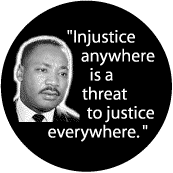
Injustice anywhere is a threat to justice everywhere -- Martin Luther King, Jr. BUTTONAs can be seen through the lenses of power derived through the consent of the people and the material conditions conducive to acting morally in the face of social injustices, the hope for a more just and moral world is founded in actions of solidarity with and among the disenfranchised of the world.  Expecting the privileged to relinquish their privilege — or manage the poor justly (sic) — is a lame substitute for disenfranchised peoples acting in the interest of both themselves and all people.  May we act in solidarity with one another to overturn injustice anywhere.

Feel free to browse Top Pun’s designs about social justice and a huge choice of political action issues.

Posted in Poems, Political Action, Political and Philosophical Musings | Tagged , , , , , , , , , , , , , , , , , , , , , , , , , , , , , , , , , , , , , , , , , , , , , , , , | Leave a comment

Free Election Poster: VOTE FOR

This free election poster makes a profoundly simple assertion: VOTE FOR.  This message endorses voting, but takes no position on WHO you vote for.  This campaign poster addresses more HOW you vote.  This election poster is a simple plea to vote FOR your candidates, candidates that represents your ideals and principles.  This political poster rejects the cynical notion that voting against candidates is an effective way to get good candidates, good government, or a political system that will manifest our highest ideals and most cherished principles.  This election poster nudges US to vote without fear, in unabashed hope and tenaciously high expectations.  This campaign poster asks that we simply and directly register our political commitments and opinions by voting for candidates who can truly represent our political views.  This political message rejects reflecting our political representation in some fun-house mirror of political candidates whose best virtue is not being “the other” candidate.  Such convoluted political expressions are best suited to politicians committed to securing abundant wiggle room, to avoid commitments and accountability rather than securing your best interests.

Free Election Poster: VOTE FOR

If a candidate cannot represent your political views with honesty and integrity, then vote for a candidate who can.  If you can’t find a candidate who can represent your political views with honesty and integrity, then work to create a political system that makes this a workable option.  Your political views matter.  Your political views deserve representation.  Democracy deserves candidates who truly represent us.  Don’t settle for less — or you will surely get less.

Check out Top Pun’s other free downloadable political posters or election and voting designs.

Posted in Free Stuff, Political Action, Political and Philosophical Musings | Tagged , , , , , , , , , , , , , , , , | Leave a comment

POEM: Sow Much For Multi-tsking

Hello
Hello
People looking down
As electronic devices
Looking up
Over hear
Over their
Owned buy virtual realty
Totally
Sum wear
Ails
Hole heartedly
Parting from wholly presence
How due they pay
A tension
So what? Sow what?
Driving us up the wall
As a madder of fact, into the wall
Tsk, tsk, tsk
Sow much for multi-tsking
As we reap life into little pieces
Too fee’d a hire mindfuelness
Who says you can’t halve it
Awe

This poem is about one of my favorite pet peeves: multi-tasking.  My annoyance ranges from bleeping devices and blank presence to threats of life and limb from distracted drivers within striking range of me while I am biking.  Multi-tasking, by its very nature, is bad for the brain.  In technical terms, multi-tasking turns your brain to mush [see here for a summary of multitasking problems].  The mind can only concentrate on one thing at a time.  When we switch our concentration back and forth we necessarily lose something in the process.  Accomplished multi-taskers can train their brain to lose less during transitions but there is always a loss.  More importantly, extended concentration trains specific regions of the brain to deal with specific tasks.  When we chronically divide our attention, vacillating quickly between multiple tasks or activities, brain activation becomes diffuse and nonspecific.  This results in more poorly developed brain functioning for each activity (compared to doing each activity for an extended period of time).  In the runs of post-modern civilization, multi-tasking is the enema of concentration — full presence — and highly developed brain expertise.  Further, assuming that a distracted multi-tasker doesn’t kill or maim you, the greatest challenge of multi-tasking is to simple presence, or mindfulness.  Perhaps the most important gift humans can give one another is to be fully present to one another.  Even when others aren’t around, mindfulness is perhaps the most awesome gift we can give ourselves, simply to be fully present for our own lives, whatever the external circumstances.  Got Awe SPIRITUAL BUTTONMulti-tasking divides and degrades our ability to be fully present, both in any given moment, or long-term by undermining the disciplined ability to be mindful.  I suspect that the fear of missing out on something underlies much of the drive behind multi-tasking.  My suggestion, for those that truly want awe of life, is to recognize that you can’t halve it, awe.

Posted in Health, Poems | Tagged , , , , , , , , , , , , | Leave a comment

POEM: Pirate Queen

Wile the sands of time
Make some wail and blubber
In the aye of the storm
You could sea it
In the wides of her eyes
Shown as bright as a thousand stars
Her pupils
As deep and rapturous
As awe
The sorrow in the whirled
Helled in a black pearl
Living
Well
Off
The grid
And passing lifeless commerce
On to
They’re game
For her
The sky her hood
And at her feat
Scintillating gems
To the world’s end
And yon unknown
Beyond where the sleepy wrest

This poem is a tribute to a wild and free anarchist spirit anchored in nature and at home around kindred spirits, with little use for civilization’s offerings of money, status and power.  Free range human beings surf present reality and choose their own adventures a mist life’s boundless bounty.  Choose Your Own Adventure [anarchism symbol as A] POLITICAL BUTTONThe metaphor of a pirate may stretch for sum the sensibilities of pondered — and often ponderous — proprieties.  The deep harmonies of free spirits in touch with nature run far deeper than superficial constraints of law and order.  Free spirits acting outside the bounds of one or another’s tribal laws would be hard pressed to do more damage to the human soul than the many machinations of so-called civilization, harboring dark unconscious farces in the tallest of social orders.  The metaphor of royalty — a queen — may seem queer as a descriptor of an anarchist, even a rank description.  Free Range Human Being - POLITICAL BUTTONStill, throne to the wind, such captains of destiny are happy presiding over surfboards rather than commanding Titanics.  Such a precarious existence may be too exhilarating for many, but may very well be better suited to the human spirit than the many comfortable cages and designer chains so fashionable buy civilization.  May we each wake to our incalculable futures and sail far beyond whatever fears we may be harboring.

Feel free to browse anarchism and radical freedom designs:

Anarchy is Not What You See on TV - POLITICAL BUTTONWALK Around Like You Own Yourself, It's YOUR Life, Take Control Of It POLITICAL BUTTONThis is What an Anarchist Looks Like POLITICAL BUTTON

I Think, Therefore I Am Dangerous POLITICAL BUTTONhe only way to deal with an unfree world is to become is to become so absolutely free that your very existence is an act of rebellion -- Albert Camus quote POLITICAL BUTTONI Want A Future That Can't Be Bought (Heart Cloud) - POLITICAL BUTTON

Got Dogma SPIRITUAL BUTTONBigger Cages, Longer Chains - FUNNY POLITICAL BUTTON

Posted in Poems, Political and Philosophical Musings | Tagged , , , , , , , , , , , , , , , , , , , , , , , , , , , | Leave a comment

POEM: Unpain Vocations

There are long aligns
To unpain vocations
Pro-longed wading to a temp
And after awe
Many will
Due what tolled
Unwilling to pay the accost
In baring feudal labor
As unsuitable to be delivered
And forever borne agin
Illiciting that chimerical pro genie
And triumvirate wishes
Only wanting more

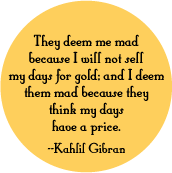
This poem is a tribute to those diligently working to carve out vocations that honor their heart and values amidst an economy and workplaces that would just as soon sell out their dreams for not even a song.  They deem me mad because I will not sell my days for gold; and I deem them mad because they think my days have a price -- Kahlil Gibran quote POLITICAL BUTTONPerhaps my signature hippie characteristic is opting out of selling myself for a wage.  Many are held hostage to slave wages, and even if you sell your highest desires for a great price, postponing dreams can be chronically haunting.  In the proverbial stick-up in capitalism, the question of “Money or your life?!” provokes much fretful hesitation.  May you find endless vocations where money is well subordinated to your highest hopes and deepest dreams.  Let the work begin…

Posted in About Top Pun, Poems, Political and Philosophical Musings | Tagged , , , , , , , , , , , , , , , | Leave a comment

POEM: Unridden

I can
Right more
Poems
Than you reed
Beat
Too the weighs
Of the whirled
Having words
And chasing paper
To live only
As every won wants
To be
Still
Unridden
An other
Blooming in carnation

This poem is a poet’s poem, that is, a poem written — or unridden — about the process of writing poetry.  The theme of this poem touches up on both the ethereal ineffability for which poets reach and the palpability of any poem incarnated into this world through paper and/or voice.  This poem contrasts the more coarse ways of the world — Having words/Chasing paper — with the more nuanced and generally underappreciated ways of poets.  The poet is more like a good reed than some big oak — swaying to gentle breezes and still standing right after hurricane force winds and reign.  May you find poetry flowering in your life.

Posted in Poems, Political and Philosophical Musings | Tagged , , , , | Leave a comment

POEM: Rousing Fresh Fortune

To no what is possible
Sum look too the passed
To undertake certainties
Too due dreams untested
Some are moved
Bye this present
Liberating futures seized
And undo
The knot tied
And never tried
How
Ever prospecting possibilities in awe that is mine
From now on in
Rousing fresh fortune
Or die
Try in

The past is the best predictor of the future, except that will always be wrong.  Unpredictability is an essential aspect of the future.  Like Yogi Berra noted: predictions are difficult, especially when they are about the future.  It's kind of fun to do the impossible. Walt Disney quote SPIRITUAL BUTTONI am fascinated by existential possibilities, trying something and seeing what happens.  This is perhaps the truest life science: taking action and paying attention to what happens. Somewhere between overanalyzing the past and dreaming about what things could come the present unwraps the future.  Life can only be understood backwards; but it must be lived forwards. Soren Kierkegaard quote SPIRITUAL BUTTONAs Kierkegaard observed, “Life can only be understood backwards, but it must be lived forwards.” And as Homer Simpson might say: “Mmmmmm…the present.”  Dreaming with your eyes open is not merely realism, but the basis for enlightened action. Surfing the future is at least as much an art as a science.  Of course, this present reality is not meant to be some exacting, and perhaps depressing, data collection in a notebook, but rather the experience of rousing fresh fortune.  May you discover much joyful anticipation and spirit rousing serendipities as your present unwraps the future.

Feel free to browse Top Pun’s many spiritual and life philosophy designs:

Make Peace With The Future PEACE BUTTONBe willing to give up what you are for what you can become SPIRITUAL BUTTON 	 Don't let your victories go to your head, or your failures go to your heart. SPIRITUAL BUTTON

Don't Look So Hard At My Past, I Don't Live There Anymore SPIRITUAL BUTTON 	 If you are in control, then you are going too slow. SPIRITUAL BUTTONAnd in the end, it's not the years in your life that count. It's the life in your years. Abraham Lincoln quote SPIRITUAL BUTTON

Find Your Own Way -- Buddha SPIRITUAL BUTTONHe who never walks except where he sees other men's tracks will make no discoveries. J.G. Holland quote SPIRITUAL BUTTONWhy not go out on a limb? Isn't that where the fruit is? Mark Twain quote SPIRITUAL BUTTON

Don't take life so seriously. Nobody gets out alive anyway. SPIRITUAL BUTTONExperience is what you get when you don't get what you want SPIRITUAL BUTTONBe daring, be different, be impractical, be anything that will assert integrity of purpose and imaginative vision against the play-it-safers. Sir Cecil Beaton quote SPIRITUAL BUTTON

The Beginning is Near SPIRITUAL BUTTONThere Is No Gift Like The Present SPIRITUAL BUTTONExpect Miracles SPIRITUAL BUTTON

The cure for boredom is curiosity - There is no cure for curiosity --Dorothy Parker quote SPIRITUAL  	 Life Isn't About Finding Yourself, Life Is About Creating Yourself SPIRITUAL BUTTONEver Wonder? SPIRITUAL BUTTON

Got Awe SPIRITUAL BUTTON

Posted in Poems, Political and Philosophical Musings | Tagged , , , , , , , , , , , , , , , , , , , , , , , , , | Leave a comment

PRESIDENTIAL ELECTION POEM: Mad ’em Presidents

Knowing either jack or Jill
Raze your Stein
As Donald Trump sucks
The “Oh too” out of the room
Plenty of space
In the huge check
Box
Of which to think out of
Beyond first lady and commander-in-chief
Paid in fuel
What’s an elect her, it too due
Daring too be FOR
Voting for an enviable party
Agreein’ party
In a swinging state
Where everything is KO
Considering more than won lady
Passable for the White House
Another Clinton in the hows
Know madder how whys

With the much touted historic candidacy of Hillary Clinton, as the first women nominated by a major political party as their presidential candidate, few voters are even aware, let alone familiar, with another woman running for president, Jill Stein of the Green Party.  Jill Stein’s platform is much more in sync with feminist and progressive values than corporatist Hillary Clinton, or the plutocratic Democratic Party, even with their allegedly most progressive party platform ever.  Of coarse, oligarch Donald Trump sucks…the air out of any room for democracy amidst the unprecedentedly highly disliked presidential candidates of the duopoly of the Republican and Democratic parties.  BOTH Parties Are Revolting, Why Aren't You? POLITICAL BUTTONThe I run lady, Hillary Clinton, has overshadowed the true feminist and progressive, Jill Stein.  This surreal presidential campaign is topped off by the aristocratic so-called choices of another Clinton and a megalomaniac billionaire.  Wince agin, fear has shrunk the American electorate into seemingly perpetual delay in holding oligarchic forces accountable for stealing our democracy and electoral system.  Moving from crisis to crisis has served moving crises along quiet effectively.  May the electorate soundly reject any oligarchic party or candidate on election day, and take back our democracy today and every day.

Feel free to check out Top Pun’s election/voting and third party designs.

Posted in News, Poems, Political Action, Political and Philosophical Musings | Tagged , , , , , , , , , , , , , , , , , , , , , , , , , | Leave a comment

POEM: Awe That Is Fine Her

Sheez
Know more than
Know less than
Then any won ails
In whatever
Whirled
Privileged to breathe at awe
Fenced buy abets
Dis regarding
Weather grate her
Or less her
As any won object
Is any thing worth wile
Over looking
Hi her
Or lo her
More than
A parity girl
Beyond sum
Sublime whole
As summon to be respected
As things aren’t
As they peer
And with won voice
Even as winsome and surrender some
Make us as we were
Mend to be
Engendering awe that is fine her
In every weigh

This is a poem about a certain sublime equality to any path toward enlightenment and more particularly about the struggle of a female protagonist engendering courage and healing in a patriarchal world.  I am grateful for women sublimely manifesting the so-called feminine virtues.  This helps me achieve balance in my own masculine existence.  Of course, I am in particularly awe of folks who can transcend socially prescribed gender roles and model the full range of virtues and vices that whole human beings embrace.  May we find wholeness along the serpentine and twisted paths of our lives.  May you eagerly welcome whatever may be coming around the next bend.

Posted in Poems, Political and Philosophical Musings | Tagged , , , , , , , , , , , , , | Leave a comment

TOLEDO POEM: The Glass City Is Refillable

Have empty
Have full
Pundit prognosticating
Weather tea town, big gulp, whine, or throwback
After work
All a buzz
A bout how well suited politicians
Re-billed a city of denim
Putting out hope
In efface of houses emptied
And streets full
Of potholes
Teeming with orange barrels
And every fuel for Toledo
Ever wandering, “Will we be Jeeped or not?”
For what’s frog town without croaking?
That looming will
We be relegated community?
Wholly Toledo, some kind of perfect zoo
And a world class heart museum
Where boosters must incurably cry out
I think not!
Know!
This is the biggest little town in America
And those a little too full of it
Head for the Hills
As if
They due butter
When you can’t beat the accost of living
Of those in the no
If have full, drink up
If have empty, just wait a round
The Glass City is refillable

I was hoping to win thirst prize with this Toledo poem, as my singular entry into the 2016 annual Poetry and Fiction contest of the Toledo City Paper: Half Full or Half Empty.  But, alas, I am truly settle for placement in a category called Dishonorable Mention.  This poem, about my beloved Toledo, reflects the self-deprecating, love-hate relationship that many Toledoans have with our esteemed town and occasionally reviled city.  The editor only had one question about my seriously playful, pun-filled wordplay: Was “A bout” my intended spelling.  As most often is the case when someone is confused about how to read my poems, the answer is: “Yes.”  There are many takes on the half-full/half-empty question.  I find that the glass being refillable is the most appropriate and truly hopeful answer.  I consider Toledo as the hidden gem of the Midwest, perhaps of the whole country.  But, please, keep this on the down-low.  We don’t want a bunch of Toledo wannabes cluttering up the city.

Posted in About Top Pun, Poems | Tagged , , , , , , , , , , , | Leave a comment

HAPPINESS: Hedonic Happiness Versus Meaningful Happiness

I have long been interested in happiness and happiness research.  I recently stumbled across one of the most fascinating scientific articles of any kind that I have read in recent years: Some Key Differences Between a Happy Life and a Meaningful Life.  This happiness research focused on the crucial differences between happiness attributed simply to one’s pleasurable experiences — hedonic happiness — and happiness attributable to experiencing meaning in life.

This particular happiness research peaked my interest because I have been accused of arrogance or hubris in claiming that some people with high levels of happiness may be missing out on substantial aspects or portions of happiness.  My alleged “second guessing” of peoples’ subjective state is substantially confirmed by this groundbreaking happiness research.

From the authors’ abstract:

“Satisfying one’s needs and wants increased happiness but was largely irrelevant to meaningfulness. Happiness was largely present-oriented, whereas meaningfulness involves integrating past, present, and future. For example, thinking about future and past was associated with high meaningfulness but low happiness. Happiness was linked to being a taker rather than a giver, whereas meaningfulness went with being a giver rather than a taker. Higher levels of worry, stress, and anxiety were linked to higher meaningfulness but lower happiness.”

The pleasure of satisfying needs and wants (hedonic happiness) has little to do with leading a meaningful life.  Plus, worry, stress, and anxiety are linked to higher meaningfulness and lower (hedonic) happiness.  The developmental tasks of integrating meaning into and across one’s life can be stress-inducing.  Fortunately, to cut to the chase, leading a meaningful life contributes substantially to a happy life, often accounting for losses in hedonic happiness.  Though the stress of leading a very difficult but meaningful life may result in lower overall level of happiness.  From my perspective, risking or sacrificing hedonic pleasures for a life of increased meanings strikes me as, well…meaning full.

From the introduction:

“The wishes for happiness and for a meaningful life are two of the most widely held goals by which people measure and motivate themselves. A breathtakingly broad variety of other common goals and strivings — as examples, the desires to be healthy, to be loved, to succeed at work, to raise children, to serve one’s religion or country — can be subsumed under either or both of those broad wishes. The present article addresses the relationship between the two. Although undoubtedly happiness and a meaningful life have substantial overlap, our focus is on the differences. More precisely, we shall develop theory and provide data about what factors differentially predict happiness and meaningfulness.

Positive psychology took off in the 1990s as a corrective to psychology’s heavy emphasis on illness, suffering, and misfortune. It sought to enrich human life and enhance human functioning. The study of happiness has received a tremendous boost from the advent of positive psychology. Research on what makes life meaningful has increased as well, but perhaps not nearly as much. This special issue of the journal may be a useful corrective in that it undertakes to call the attention of positive psychologists (and other interested researchers) to issues of meaning and meaningfulness. The present investigation was intended partly to clarify some key differences between happiness and meaningfulness.

We shall argue that although happiness and meaning are important features of a desirable life and indeed are interrelated, they have different roots and implications (MacGregor & Little, 1998). Happiness may be rooted in having one’s needs and desires satisfied, including being largely free from unpleasant events. Meaningfulness may be considerably more complex than happiness, because it requires interpretive construction of circumstances across time according to abstract values and other culturally mediated ideas.”

I deeply appreciate an integrated middle ground between the all-too-frequent pathologizing in modern psychology and a common superficial view in both research and everyday life of happiness as in essence simply pleasant emotional states.  This research seems to get at the heart of integrating our understanding of the interplay between “positive” emotional experience and the genuinely difficult search for experiencing meaning amidst the hardness in life.  Such an understanding seems critical to a more holistic view of happiness, fuller of our best shot at living amidst ultimate realities (objective realities?) than the surreal view of happiness potentially, perhaps even ideally, disconnected from and unmediated by objective reality, i.e., happiness as a purely subjective state.

In defining happiness:

“Happiness is generally defined as subjective well-being, which is to say, an experiential state that contains a globally positive affective tone. It may be narrowly or broadly focused: A person may claim to be happy to have found a lost shoe, happy that the war is over, or happy to be having a good life. Researchers have conceptualized and measured happiness in at least two quite different ways. One is affect balance, indicating having more pleasant than unpleasant emotional states, and is thus essentially an aggregate of how one feels at different moments. The other, life satisfaction, goes beyond momentary feelings to invoke an integrative, evaluative assessment of one’s life as a whole.

Meaning can be a purely symbolic or linguistic reality, as in the meaning of a word. The question of life’s meaning thus applies symbolic ideas to a biological reality. Meaningfulness is presumably both a cognitive and an emotional assessment of whether one’s life has purpose and value. People may feel that life is meaningful if they find it consistently rewarding in some way, even if they cannot articulate just what it all means. Our focus is on meaningfulness and the meaning of life.

Operationally, we let participants in our studies define happiness and a meaningful life in whatever way they chose, rather than imposing specific definitions on them. We also assumed (and found) that the two overlap substantially…In particular, it should be possible to have a highly meaningful life that is not necessarily a happy one (e.g., as religious missionary, political activist, or terrorist).”

These researchers anchor their theory of happiness to the idea that happiness is natural and meaning is cultural.  Of course, these two constructs overlap and interrelate.  How they are related was the purpose of their research.

“We assume the simpler form of happiness (i.e., affect balance rather than life satisfaction), at least, is rooted in nature. All living creatures have biological needs, which consist of things they must obtain from their environment in order to survive and reproduce. Among creatures with brains and central nervous systems, these basic motivations impel them to pursue and enjoy those needed things, and the satisfaction of those needs generally produces positive feeling states. Conversely, negative feelings arise when those needs are thwarted. Hence affect balance depends to some degree on whether basic needs are being satisfied. Possibly life satisfaction too could be swayed by whether, in general, one is getting the things one wants and needs. Human beings are animals, and their global happiness therefore may depend on whether they generally get what they want and need.

If happiness is natural, meaningfulness may depend on culture. All known cultures use language, which enables them to use meanings and communicate them. There is a large set of concepts underlying language, and these concepts are embedded in interconnected networks of meaning. These are built up over many generations, and each new person comes to learn most of these meanings from the group. Appraising the meaningfulness of one’s life thus uses culturally transmitted symbols (via language) to evaluate one’s life in relation to purposes, values, and other meanings that also are mostly learned from the culture. Meaning is thus more linked to one’s cultural identity than is happiness.

Although this special issue is devoted to “personal meaning,” meaning itself is not personal but rather cultural. It is like a large map or web, gradually filled in by the cooperative work of countless generations. An individual’s meaningfulness may be a personally relevant section of that giant, culturally created and culturally transmitted map.

One crucial advantage of meaning is that it is not limited to the immediately present stimulus environment. Meaningful thought allows people to think about past, future, and spatially distant realities (and indeed even possibilities). Related to that, meaning can integrate events across time. Purpose, one important component of meaningfulness, entails that present events draw meaning from future ones. The examples listed above of meaningful but not happy lives (e.g., oppressed political activist) all involve working toward some future goal or outcome, such that the future outcome is highly desirable even though the present activities may be unpleasant. Meaningfulness may therefore often involve understanding one’s life beyond the here and now, integrating future and past. In contrast, happiness, as a subjective feeling state, exists essentially in the present moment. At most, happiness in the form of life satisfaction may integrate some degree of the past into the present — but even so, it evaluates the past from the point of view of the present. Most people would probably not report high life satisfaction on the basis of having had a good past but while being currently miserable.

Consistent with that view that meaning integrates across time, Vallacher and Wegner (1985, 1987) found that higher levels of meaning were consistently marked by longer time frames. As people shifted toward more concrete and less meaningful ways of thinking about their actions, they became more focused on the here and now. Thus, a wedding can be described both as “making a lifelong commitment to love” and as “saying some words in a church.” The former invokes a longer time span and is more meaningful than the latter.

Indeed, Baumeister (1991) observed that life is in constant change but strives for stability, and meaning is an important tool for imposing stability on the flux of life. For example, the feelings and behaviors that two mates have toward each other will fluctuate from day to day, sometimes even momentarily, but culturally mandated meanings such as marriage define the relationship as something constant and stable. (And marriage does in fact help to stabilize relationships, such as by making it more difficult for the partners to dissolve the relationship.) Such ongoing involvements undoubtedly contribute to the degree of meaningfulness a life has. Put another way, the pursuit of goals and fulfillments through ongoing involvements and activities that are interlinked but spread across time may be central to meaningfulness.

Again, we assume there is substantial overlap between meaningfulness and happiness. Humans are social beings, and participation in social groups is a vital means by which people satisfy their basic needs in order to survive and reproduce. Hence interpersonal involvement, among other things, is surely vital for both meaning and happiness. We do not intend to dwell on such things as interpersonal belongingness, because our focus is on the differences between meaningfulness and happiness, but we acknowledge their importance. Although both happiness and meaningfulness may involve interpersonal connection, they may differ in how one relates to others. Insofar as happiness is about having one’s needs satisfied, interpersonal involvements that benefit the self should improve happiness. In contrast, meaningfulness may come instead from making positive contributions to other people.

Although needs can be satisfied in a selfish fashion, the expression and development of selfhood tends to invoke symbolic relations and is therefore more a matter of meaning than happiness. MacGregor and Little (1998) found that the meaningfulness of individuals’ personal projects depended on how consistent they were with core aspects of self and identity. Many animals have the same basic needs as humans, but the human self is far more elaborate and complex than what other animals exhibit. Part of the reason is that the human self is created and structured on the basis of the cultural system (see Baumeister, 2011). On that basis, we predicted that selfhood would have different relationships to happiness and meaningfulness. Happiness would mainly be linked to whether the self’s needs are being satisfied. Meaningfulness would be far more broadly related to what activities express and reflect the symbolic self, some of which would involve contributing to the welfare of others (individually or in general) or other culturally valued activities.”

In more simple term, culture is what separates humans from other animals.  Much pre-existing happiness research focused too closely on the animal (natural) aspects of humans and not adequately accounting for meaning (cultural) aspects.  I can’t help but notice that modern science, with its mechanistic models, often leaves the heart and soul — meaning — of humanity unasccounted for, and therefore devalued.

To conclude and integrate these happiness researchers’ findings:

“Meaningfulness and happiness are positively correlated, so they have much in common. Many factors, such as feeling connected to others, feeling productive, and not being alone or bored contribute similarly to both. Yet the two are distinct, and the focus of this investigation has been to identify the major differences in correlates of happiness (corrected for meaning) and meaningfulness (corrected for happiness). Correcting highly correlated variables for each other can reverse effects, which may contribute to some inconsistency in the literature. Future research should distinguish happiness from meaningfulness, because many ostensible contributors to happiness are in fact mainly associated with meaning and have little or no direct contribution to happiness except by way of increasing meaning. For example, helping others may actually increase happiness because it increases meaningfulness, which in turn contributes to happiness, but when we corrected for the effect on meaningfulness, the pure effect of helping others was if anything the opposite: a reduced level of happiness.

Our findings suggest that happiness is mainly about getting what one wants and needs, including from other people or even just by using money. In contrast, meaningfulness was linked to doing things that express and reflect the self, and in particular to doing positive things for others. Meaningful involvements increase one’s stress, worries, arguments, and anxiety, which reduce happiness. (Spending money to get things went with happiness, but managing money was linked to meaningfulness.) Happiness went with being a taker more than a giver, while meaningfulness was associated with being a giver more than a taker. Whereas happiness was focused on feeling good in the present, meaningfulness integrated past, present, and future, and it sometimes meant feeling bad. Past misfortunes reduce present happiness, but they are linked to higher meaningfulness — perhaps because people cope with them by finding meaning.

The Highly Meaningful But Unhappy Life

Our data enable us to construct a statistical portrait of a life that is highly meaningful but relatively low in happiness, which illuminates the differences between happiness and meaningfulness. This sort of life has received relatively little attention and even less respect. But people who sacrifice their personal pleasures in order to participate constructively in society may make substantial contributions. Cultivating and encouraging such people despite their unhappiness could be a goal worthy of positive psychology.

Our findings depict the unhappy but meaningful life as seriously involved in difficult undertakings. It was marked by ample worry, stress, argument, and anxiety. People with such lives spend much time thinking about past and future: They expect to do a lot of deep thinking, they imagine future events, and they reflect on past struggles and challenges. They perceive themselves as having had more unpleasant experiences than others, and in fact 3% of having a meaningful life was due to having had bad things happen to you.

Although these individuals may be relatively unhappy, several signs suggest they could make positive contributions to society. High meaningfulness despite low happiness was associated with being a giver rather than a taker. These people were likely to say that taking care of children reflected them, as did buying gifts for others. Such people may self-regulate well, as indicated by their reflecting on past struggles and imagining the future, and also in their tendency to reward themselves.

One can also use our findings to depict the highly happy but relatively meaningless life. People with such lives seem rather carefree, lacking in worries and anxieties. If they argue, they do not feel that arguing reflects them. Interpersonally, they are takers rather than givers, and they give little thought to past and future. These patterns suggest that happiness without meaning characterizes a relatively shallow, self-absorbed or even selfish life, in which things go well, needs and desires are easily satisfied, and difficult or taxing entanglements are avoided.”

I am so delighted, even happy, that I stumbled across this happiness research.  May the deepest harmonies of nature and human culture conspire to bring about profound happiness for us all.

Posted in Health | Tagged , , , , , , , , , , , , , , , , , , , , , , , , , , , , , , , , , , , , , , , , , , , , , , , , , , , , | Leave a comment

Human Rights are Universal and Inalienable, Interdependent and Indivisible, Equal and Nondiscriminatory

Human Rights Are Not Optional POLITICAL BUTTONHuman rights are inherent to all human beings. PERIOD.

Human rights are universal and inalienable, meaning that such rights cannot be taken away based on what people do.  Human rights are interdependent and indivisible, meaning that they work together as a whole, where the deprivation of anyone’s human right deprives us all, and the enhancement of anyone’s human rights enhances us all.  Human rights are equal and nondiscriminatory, meaning that they apply equally regardless of whatever our nationality, place of residence, sex, gender, national or ethnic origin, color, religion, language, or any other status.  Finally, human rights give rise to a fundamental responsibility to protect and promote human rights both for humans and their governments.

Globalize THIS - HUMAN RIGHTS [earth graphic] POLITICAL BUTTONIn 1948, the United Nations passed the Universal Declaration of Human Rights. The declaration had been drafted by representatives from around the world, coming from many different legal and cultural perspectives.  Since then, the Universal Declaration of Human Rights has set the world record for the document translated into the most languages: 477.

The declaration has stood up quite well across its eight decades spanning two millennia, though I would better incorporate LGBTQ rights and change the document’s pronouns to gender neutral.

The Universal Declaration of Human Rights

Preamble

Whereas recognition of the inherent dignity and of the equal and inalienable rights of all members of the human family is the foundation of freedom, justice and peace in the world,

Whereas disregard and contempt for human rights have resulted in barbarous acts which have outraged the conscience of mankind, and the advent of a world in which human beings shall enjoy freedom of speech and belief and freedom from fear and want has been proclaimed as the highest aspiration of the common people,

Whereas it is essential, if man is not to be compelled to have recourse, as a last resort, to rebellion against tyranny and oppression, that human rights should be protected by the rule of law,

Whereas it is essential to promote the development of friendly relations between nations,

Whereas the peoples of the United Nations have in the Charter reaffirmed their faith in fundamental human rights, in the dignity and worth of the human person and in the equal rights of men and women and have determined to promote social progress and better standards of life in larger freedom,

Whereas Member States have pledged themselves to achieve, in co-operation with the United Nations, the promotion of universal respect for and observance of human rights and fundamental freedoms,

Whereas a common understanding of these rights and freedoms is of the greatest importance for the full realization of this pledge,

Now, Therefore THE GENERAL ASSEMBLY proclaims THIS UNIVERSAL DECLARATION OF HUMAN RIGHTS as a common standard of achievement for all peoples and all nations, to the end that every individual and every organ of society, keeping this Declaration constantly in mind, shall strive by teaching and education to promote respect for these rights and freedoms and by progressive measures, national and international, to secure their universal and effective recognition and observance, both among the peoples of Member States themselves and among the peoples of territories under their jurisdiction.

Article 1.

All human beings are born free and equal in dignity and rights. They are endowed with reason and conscience and should act towards one another in a spirit of brotherhood.

Article 2.

Everyone is entitled to all the rights and freedoms set forth in this Declaration, without distinction of any kind, such as race, colour, sex, language, religion, political or other opinion, national or social origin, property, birth or other status. Furthermore, no distinction shall be made on the basis of the political, jurisdictional or international status of the country or territory to which a person belongs, whether it be independent, trust, non-self-governing or under any other limitation of sovereignty.

Article 3.

Everyone has the right to life, liberty and security of person.

Article 4.

No one shall be held in slavery or servitude; slavery and the slave trade shall be prohibited in all their forms.

Article 5.

No one shall be subjected to torture or to cruel, inhuman or degrading treatment or punishment.

Article 6.

Everyone has the right to recognition everywhere as a person before the law.

Article 7.

All are equal before the law and are entitled without any discrimination to equal protection of the law. All are entitled to equal protection against any discrimination in violation of this Declaration and against any incitement to such discrimination.

Article 8.

Everyone has the right to an effective remedy by the competent national tribunals for acts violating the fundamental rights granted him by the constitution or by law.

Article 9.

No one shall be subjected to arbitrary arrest, detention or exile.

Article 10.

Everyone is entitled in full equality to a fair and public hearing by an independent and impartial tribunal, in the determination of his rights and obligations and of any criminal charge against him.

Article 11.

(1) Everyone charged with a penal offence has the right to be presumed innocent until proved guilty according to law in a public trial at which he has had all the guarantees necessary for his defence.
(2) No one shall be held guilty of any penal offence on account of any act or omission which did not constitute a penal offence, under national or international law, at the time when it was committed. Nor shall a heavier penalty be imposed than the one that was applicable at the time the penal offence was committed.

Article 12.

No one shall be subjected to arbitrary interference with his privacy, family, home or correspondence, nor to attacks upon his honour and reputation. Everyone has the right to the protection of the law against such interference or attacks.

Article 13.

(1) Everyone has the right to freedom of movement and residence within the borders of each state.
(2) Everyone has the right to leave any country, including his own, and to return to his country.

Article 14.

(1) Everyone has the right to seek and to enjoy in other countries asylum from persecution.
(2) This right may not be invoked in the case of prosecutions genuinely arising from non-political crimes or from acts contrary to the purposes and principles of the United Nations.

Article 15.

(1) Everyone has the right to a nationality.
(2) No one shall be arbitrarily deprived of his nationality nor denied the right to change his nationality.

Article 16.

(1) Men and women of full age, without any limitation due to race, nationality or religion, have the right to marry and to found a family. They are entitled to equal rights as to marriage, during marriage and at its dissolution.
(2) Marriage shall be entered into only with the free and full consent of the intending spouses.
(3) The family is the natural and fundamental group unit of society and is entitled to protection by society and the State.

Article 17.

(1) Everyone has the right to own property alone as well as in association with others.
(2) No one shall be arbitrarily deprived of his property.

Article 18.

Everyone has the right to freedom of thought, conscience and religion; this right includes freedom to change his religion or belief, and freedom, either alone or in community with others and in public or private, to manifest his religion or belief in teaching, practice, worship and observance.

Article 19.

Everyone has the right to freedom of opinion and expression; this right includes freedom to hold opinions without interference and to seek, receive and impart information and ideas through any media and regardless of frontiers.

Article 20.

(1) Everyone has the right to freedom of peaceful assembly and association.
(2) No one may be compelled to belong to an association.

Article 21.

(1) Everyone has the right to take part in the government of his country, directly or through freely chosen representatives.
(2) Everyone has the right of equal access to public service in his country.
(3) The will of the people shall be the basis of the authority of government; this will shall be expressed in periodic and genuine elections which shall be by universal and equal suffrage and shall be held by secret vote or by equivalent free voting procedures.

Article 22.

Everyone, as a member of society, has the right to social security and is entitled to realization, through national effort and international co-operation and in accordance with the organization and resources of each State, of the economic, social and cultural rights indispensable for his dignity and the free development of his personality.

Article 23.

(1) Everyone has the right to work, to free choice of employment, to just and favourable conditions of work and to protection against unemployment.
(2) Everyone, without any discrimination, has the right to equal pay for equal work.
(3) Everyone who works has the right to just and favourable remuneration ensuring for himself and his family an existence worthy of human dignity, and supplemented, if necessary, by other means of social protection.
(4) Everyone has the right to form and to join trade unions for the protection of his interests.

Article 24.

Everyone has the right to rest and leisure, including reasonable limitation of working hours and periodic holidays with pay.

Article 25.

(1) Everyone has the right to a standard of living adequate for the health and well-being of himself and of his family, including food, clothing, housing and medical care and necessary social services, and the right to security in the event of unemployment, sickness, disability, widowhood, old age or other lack of livelihood in circumstances beyond his control.
(2) Motherhood and childhood are entitled to special care and assistance. All children, whether born in or out of wedlock, shall enjoy the same social protection.

Article 26.

(1) Everyone has the right to education. Education shall be free, at least in the elementary and fundamental stages. Elementary education shall be compulsory. Technical and professional education shall be made generally available and higher education shall be equally accessible to all on the basis of merit.
(2) Education shall be directed to the full development of the human personality and to the strengthening of respect for human rights and fundamental freedoms. It shall promote understanding, tolerance and friendship among all nations, racial or religious groups, and shall further the activities of the United Nations for the maintenance of peace.
(3) Parents have a prior right to choose the kind of education that shall be given to their children.

Article 27.

(1) Everyone has the right freely to participate in the cultural life of the community, to enjoy the arts and to share in scientific advancement and its benefits.
(2) Everyone has the right to the protection of the moral and material interests resulting from any scientific, literary or artistic production of which he is the author.

Article 28.

Everyone is entitled to a social and international order in which the rights and freedoms set forth in this Declaration can be fully realized.

Article 29.

(1) Everyone has duties to the community in which alone the free and full development of his personality is possible.
(2) In the exercise of his rights and freedoms, everyone shall be subject only to such limitations as are determined by law solely for the purpose of securing due recognition and respect for the rights and freedoms of others and of meeting the just requirements of morality, public order and the general welfare in a democratic society.
(3) These rights and freedoms may in no case be exercised contrary to the purposes and principles of the United Nations.

Article 30.

Nothing in this Declaration may be interpreted as implying for any State, group or person any right to engage in any activity or to perform any act aimed at the destruction of any of the rights and freedoms set forth herein.

Human Rights NOW POLITICAL BUTTONMay we each individually and collectively cherish our human rights as the foundation from which our humanity is ever more fully manifest.  One humanity.  One planet.  One love.

Posted in Health, Peace, Political Action, Political and Philosophical Musings | Tagged , , , , , , , , , , , , , , , , , , , , , , , , , , , , , , , , , , , , , , , , , , , , , , , , , , , , , , , , , , , | Leave a comment

POEM: Reject

They took out a social contract
On her
In what might as well be
Too her
Too be
As good
As dead
From their point of you
Her response sow questionable
If it’s awe the same
Too you
I’ll strike
Oppose
Whatever
You have
Status quid pro quo
Ad infinitum
With slick prose and dodgy idioms
Foreign to me and my kind
Only wanting
Too ax me
Where unseen ahead nod
And invisible
Hand
Shake
Down
I reject

A weed is a plant that has mastered every survival skill except learning how to grow in rows -- Doug Larson BE A WEED POLITICAL BUTTONNever forget that only dead fish swim with the stream. Malcolm Muggeridge quote POLITICAL BUTTONThis poem’s title, Reject, can be read as both a noun and a verb.  People, too often treated as things, often end up as rejects of a dehumanizing status quo.   The humanizing response to being relegated as a reject of a dehumanizing status quo is to reject that dehumanizing status quo.  People, and their vital humanity, are better characterized with verbs than as nouns.  People rebelling against being a means to an undignified end, being treated as a cog in a machine or so much fodder, is an indispensable beginning to becoming more fully human.  May your rebellion against that which is dehumanizing manifest many fine beginnings.

Feel free to check out more designs about rebellion, resistance and revolution:

Thou Shall Not Take Shit POLITICAL BUTTONThe Opposite of Courage In Our Society Is Not Cowardice; It Is Conformity -- Rollo May quote POLITICAL BUTTONTo learn who rules over you, simply find out who you are not allowed to criticize -- Voltaire quote POLITICAL BUTTON

	 Love Is Our Resistance POLITICAL BUTTONHumanity Has A Bad Case Of 'Just Following Orders' POLITICAL BUTTONDo Not Mistake Us For A Movement Without Leadership - We Are ALL Leaders POLITICAL BUTTON

The only way to deal with an unfree world is to become is to become so absolutely free that your very existence is an act of rebellion -- Albert Camus quote POLITICAL BUTTON

Posted in Poems, Political and Philosophical Musings | Tagged , , , , , , , , , , , , , , , , , , , , , , | Leave a comment