Today, the Mitt Romney campaign held a “victory” rally at the Seagate center in downtown Toledo, Ohio. Top Pun ran into a mitt-full of cards as the Romney campaign drew a full house; but, as the rain fell, Top Pun declared victory is he drew a royal flush from the Romney campaign, being banned from the event even though possessing a ticket and a media pass. As the rain fell, Romney supporters lined up two by two around their concrete ark, hoping to save themselves from extinction. As the Romney-ites waded patiently to see their would-be monarch, I could tell by the many white faces that this wasn’t the servants entrance! Of course, there were many tanned Romney-ites, but most seem to have vacationed South, or had a tad freaky spray-on or tanning booth tan — perhaps emulating their feckless leader. Even given the many wet backs that were present, few would be mistaken for Latino. The only African-Americans I saw near the Romney lineup were button and T-shirt vendors.
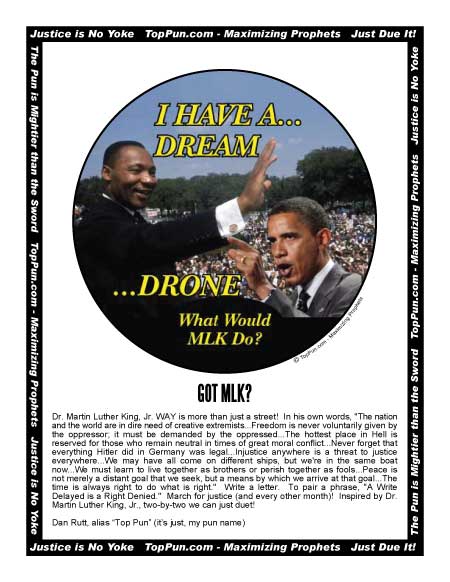
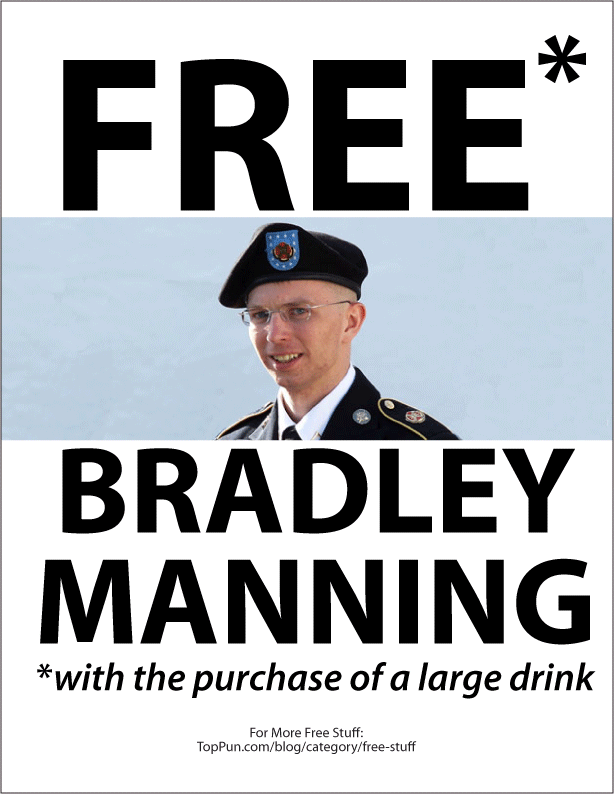
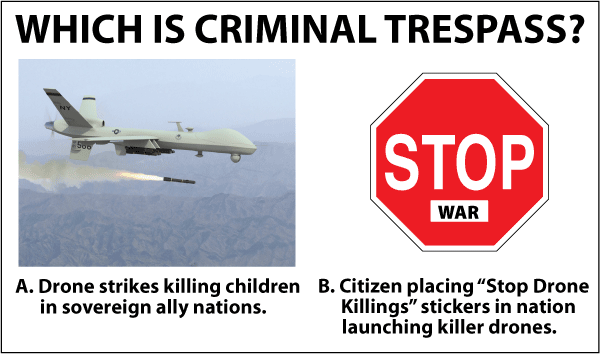
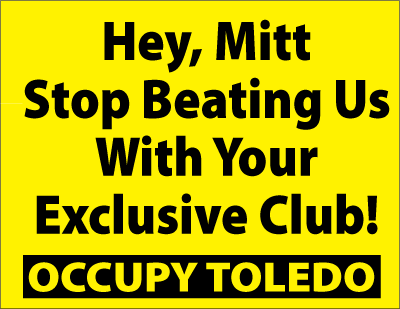
Of course, across the street, there was an anti-Romney protest that was much more colorful! One protester even wrapped themselves in the flag, a gay pride flag, that is. Not wishing to be restrained by the designated “free speech zone,” I protested outside the box. I took the opportunity to walk back and forth on the sidewalk alongside the Romney lineup (with few unusual suspects), of course, with my signs:



The Romney crowd, perhaps not so surprisingly, responded with vitriol. At one point I chanted, “Can someone give me a nice hello, and end of this ugly vitriol.” One woman asked me if I even knew what a blind trust was. I trust that she did. Many in the Romney lineup told me to go to the other side of the street; I suppose in some attempt to keep like with like, and perhaps, hate with hate?! As I walked up and down the so-called Romney side of the street, even a sheriff’s deputy told me to get on the other side of the street. When I told him that I knew my rights, and that walking down the public sidewalk and not blocking the public sidewalk was simply exercising my free speech, the sheriff deputy responded: “Would you be walking along here if this were an Obama event?” I told him that if this Romney event were not happening, that I would have been in Bowling Green protesting the Obama campaign event (likely with a drone and anti-war message). He told me again that I could not be on the side of the street. When I persisted in claiming my first amendment free speech right to be there, he said that I was becoming disorderly. I turned and walked the other way, continuing to walk back and forth, but keeping an eye out for him and his comrades. The saddest part of this encounter is that the sheriff deputy was apparently proscribing a particular type of free speech — like free speech depends on whether you support Romney, Obama, another, or nobody at all!
The most popular response from the Romney crowd was: “Get a job,” often with some ‘hippie’ or ‘cut-your-hair’ comment thrown in for good measure. Occasionally, I responded with “I have a job; in fact, I am self-employed, I created my own job.” Sometimes I might throw in “I even left a government job,” but nary a poker face yielded any approval. Once, when a Romney-ite was particularly uncivil to me, and I requested that we at least be civil, a woman in the crowd showed approval. I did experience two Romney-ites threatening violence. The first was when I overheard a man say to the crowd, “Do you want me to beat up the hippie?” I asked him if he was threatening violence to me and he said, “It’s an offer.” The other person, a man, or perhaps man-wannabe, said “I’ll beat your face in.” I asked him if he was threatening violence to me and he said, “Yes.” I asked him if he’d like me to call law enforcement over and he said, “Yes.” Well, his bully talk didn’t faze my walk. Just goes to show, you can usually rely on the general cowardice of humankind (human-unkind?).
On this rainy day, God rained on the just and the unjust. Most of the Romney-ites hugged the publicly financed Seagate center rationally seeking shelter so as to not tax their dry wits. And, since the first shall be last and the last shall be first, I joined the Romney-ites, the end of a long line. I had secured online the night before my ticket to the event Being practically soaked to the bone, having paid my dews in the open streets, the ink was running on the ticket that I had printed out and the scanner failed to read it. I was told to wait for a higher power. What more irony could I ask for then cryptic ink running on a ruinous ticket. Of course, not relying on serendipitous irony, I had brought a brown manila envelope containing my tax returns for the last 10 years (actually, which are heavily redacted blank sheets of paper). Knowing that airport-like security was to be the order of the day, security personnel would likely ask me to open this envelope. Then, I would respond that I was hoping that if I gave Mitt my tax returns then maybe he would give me his. I knew that this would probably not be satisfactory, and my alleged tax returns would be declared a security threat and the irony would be complete! In the meantime, while I was waiting for a boss-man’s stamp of approval for entrance, the young man with a scanner, the first line of security, saw that I had registered by name as “Top Pun,” and he asked me for some ID. I showed him my media pass (shown below) and my driver’s license. I told him that I was the soul proprietor of the business, that I wrote a blog, and that I was going to report on this event. He asked me what kind of business it was. I told him that I make things like buttons and T-shirts, pointing to my mission statement emblazoned on the media pass and business card, “Maximizing Prophets.” He didn’t seem to have anything to say to this. Just then, a man came out and said that the doors would be closed and locked, so if you wanted to get in, get in now. The young man with a scanner tried to scan my ticket again and it worked! I went through the two sets of doors and got in a short line for their main security check. However, as I waited in the security line, another man told the dozen or so of us waiting at security that the fire marshal said they were full and we had to leave. We went outside. After a little while, someone came back out and said that we could go in again. Again, I got in the security line. Just as I had emptied my pockets and the woman at security asked about the brown manila envelope, a sheriff deputy called me back through the set of doors. The sheriff deputy instructed me that the event organizers would not let me in their event. There it was: I was officially uninvited from the Romney victory rally. Be the change you want to see in the world. Now, if we could only all get uninvited from a Romney victory rally…